
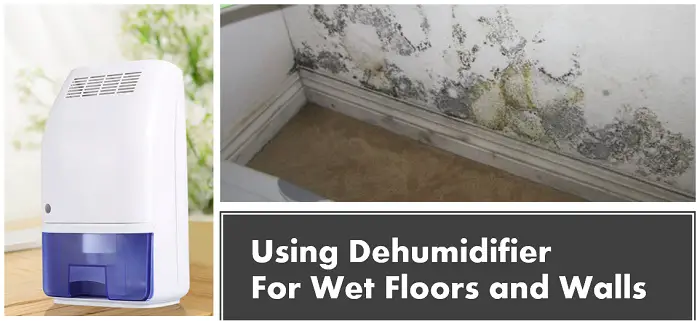
When water sneaks into your home—whether from a leak, an overflowing washer, a busted pipe, a wet bathroom floor that won’t dry, or a storm that decided to redecorate your living room—the aftermath is more than just a wet mess.
Moisture trapped inside floors, walls, baseboards, floorboards, and even wallpapers can trigger serious issues: warping, swelling, foul odors, subfloor decay, mold growth, and long-term indoor air-quality problems.
Fixing the visible puddle is easy; drying the hidden moisture is the real challenge.
This is where the humble dehumidifier steps in—not as a magical “water-sucker” but as a scientifically engineered moisture-reduction machine that can accelerate drying, stabilize humidity, protect materials, and restore your indoor environment far more effectively than most people realize.
In this guide, you’ll learn not just how to dry wet floors and walls using a dehumidifier, but also why it works, where people go wrong, how long each material takes to dry, and when to bring in additional equipment.
Let’s begin.
Dehumidifier for Wet Floors – Does it Work?
Yes, it works—but not the way many people think.
A dehumidifier does not vacuum liquid water off a wet floor. This means you should not expect your machine to suck the collected water from wet floors.
If there’s still standing water, mopping, wet vacs, and extraction tools must go first.
What a dehumidifier can do is:
- Remove excess moisture from the air, preventing the floor from reabsorbing humidity
- Pull moisture out of porous surfaces (wood, drywall, concrete, subflooring) by creating a moisture gradient
- Help evaporate the remaining water trapped within materials like wet floorboards and carpets
- Accelerate the drying cycle after water damage
When used correctly, a dehumidifier device can significantly reduce the time needed to dry hardwood, concrete slabs, laminate, and even drywall. But it does not pull out standing water from wet floors.
If you ever wondered whether placing a dehumidifier on wet floors helps—yes, in many cases it does, but positioning matters more than touching the floor itself.
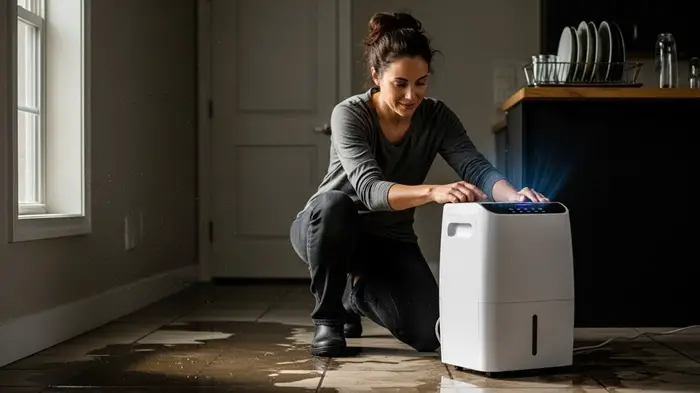
How to Use a Dehumidifier to Dry Out Wet Floors?
Drying floors properly using a dehumidifier is both a technique and a strategy. Here’s the practical, technical step-by-step process you should follow to get the maximum benefits.
1. Start with water removal (never skip this step)
Before turning on your dehumidifier:
- Remove standing water using towels, wet vacs, or pumps
- Lift rugs and mats
- Press out moisture from carpets if needed
A dehumidifier cannot remove liquid water—it only helps once the surface is damp, not flooded.
2. Increase air circulation
For maximum efficiency:
- Turn on ceiling fans or box fans
- Open windows only if the outside humidity is lower than indoors
- Use blower fans for large water-damaged rooms
This increases evaporation—without it, the dehumidifier works unnecessarily harder.
3. Position the dehumidifier correctly
Despite myths, placing a dehumidifier on wet floors is optional. What matters more is airflow and choosing the right dehumidifier.
Ideal setup:
- Place 2–3 feet away from the wettest area
- Ensure the intake side faces the moisture source
- Keep at least 6–8″ clearance for airflow
- For carpets—raise the dehumidifier slightly on a dry board to improve air pull
If you want to dry your floor faster, you may combine a dehumidifier with fans.
When choosing a smart dehumidifier for a wet floor problem, pick one with a high extraction capacity (50–70 pints/day or commercial-grade for heavy damage), strong airflow (CFM), a continuous drain option, and the ability to run at low humidity settings around 30–35% RH.
Also, look for accurate humidity sensors, durable filters, and easy portability so you can move it between rooms. A high-capacity, high-airflow unit will always dry wet floors faster and more efficiently.
4. Use the correct dehumidifier settings
Once you have picked your unit smartly, remember that low, casual settings won’t cut it for water damage. You want aggressive moisture removal.
Below is a simple dehumidifier settings chart to dry the floor:
| Room Humidity Level | Recommended Setting | Effect |
|---|---|---|
| 60–80% (mild wetness) | 45–50% RH | Slow but steady drying |
| 80–90% (damp floors) | 35–45% RH | Faster drying, safer for wood |
| 90%+ (after water damage) | 30–35% RH (short-term) | Rapid moisture extraction |
Important: Avoid running below 30% RH for long periods, as extreme dryness can cause wooden flooring or baseboards to crack.
This is why some people worry that a dehumidifier makes walls too dry. It can happen—but only if settings are misused.
5. Empty or drain continuously
A dehumidifier pulls a surprising amount of moisture from wet floors and walls, so keeping it draining continuously is essential for uninterrupted drying.
Most units allow you to attach a hose that routes water directly into a floor drain, sink, or utility outlet, preventing the machine from shutting off when the bucket fills.
If you’re using the built-in tank and it fills rapidly—sometimes every 30–60 minutes—it’s a clear sign that the flooring, subfloor, or walls are holding more moisture than expected.
Continuous drainage not only saves time but also ensures the dehumidifier maintains maximum efficiency throughout the entire drying process.
Use additional tools for the best results, and keep the room closed while drying
Sometimes, especially after major water damage, you’ll need:
- Axial fans
- Air movers
- Heaters to boost evaporation
- Infrared moisture meters
- Equipment to dry damp walls, like wall cavity dryers
You can even rent a room dehumidifier to dry the walls and flooring if your home unit isn’t strong enough.
Also, it helps to seal the room temporarily so the dehumidifier can control humidity effectively.
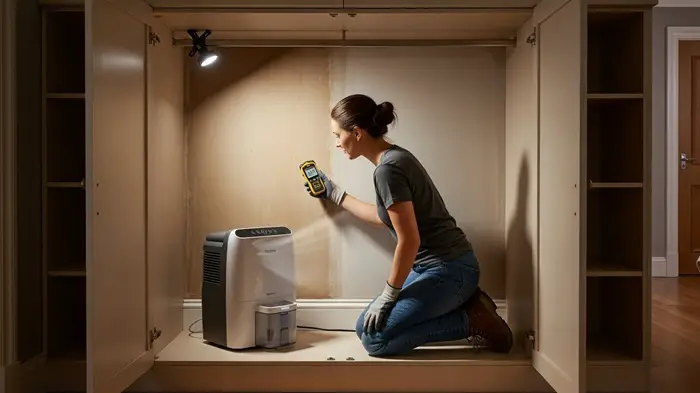
Can You Dry Out a Wall Inside a Cupboard with a Dehumidifier?
Yes, a dehumidifier helps with extracting the moisture out of walls inside a cupboard, but not by placing the machine inside the cupboard.
Instead, you need to create proper airflow and exposure.
- Start by fully opening the cupboard doors and removing clothes, boxes, and stored items so the wall can breathe.
- Then improve circulation by placing a small fan inside the cavity while running a dehumidifier nearby to pull moisture through the open space.
Cupboards are natural moisture traps, so if the wall has soaked water from seepage or condensation, remove any mouldy boards, dry out the baseboards, and check whether the back panel or insulation needs replacement.
Most importantly, use a digital moisture meter to monitor the wall’s drying progress; the surface may look dry long before the internal moisture drops to safe levels.
Because the area is enclosed, airflow matters more than raw dehumidifier power. If the problem keeps returning, you may need to dehumidify the property after water damage at a structural level.
How Long Does it Take to Dry Hardwood Floors Using a Dehumidifier?
Drying hardwood is a delicate process. Wood absorbs water more slowly than carpet, but releases it even more slowly.
Typical drying times when using a dehumidifier for wet floors and walls are:
- Light surface moisture: 24–48 hours
- Moderate moisture: 3–5 days
- Heavy water damage: 5–10 days
- Severe flooding (water between planks): 2–3 weeks, with airflow systems
Factors affecting the drying speed are as follows:
- Thickness of the Boards – Thicker boards hold more moisture and require more time.
- Sealant and Finish – Polyurethane surfaces slow down evaporation, meaning more time is needed.
- Room Temperature – Warm rooms dry faster because evaporation is temperature-driven.
- How Quickly You Responded – The sooner you start drying, the less the wood swells.
- Use of Fans or Heaters – Pairing fans with a dehumidifier pulls water out of wet flooring significantly faster.
Besides the above, the subfloor type also matters.
- Plywood dries faster
- Concrete subfloors dry more slowly and can reintroduce moisture
- Suspended subfloors dry moderately fast
Important: If you see cupping, crowning, or boards lifting, the dehumidifier may help stabilize humidity but might not reverse mechanical damage.
In some cases, a dehumidifier solves floor and subfloor gap issues by removing trapped moisture—but only early on.
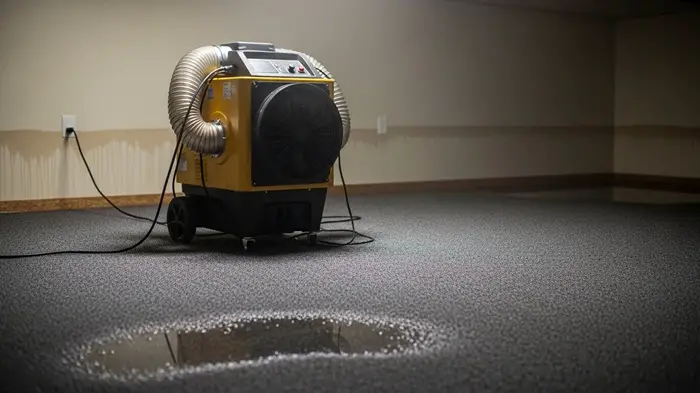
Can a Dehumidifier Also Help Prevent Mold and Mildew Growth on Wet Carpets?
Absolutely—this is one of its strongest roles.
Carpets are mold factories when damp. The fibers, backing, and underlay all hold moisture, and the subfloor beneath traps humidity.
Using dehumidifiers for wet carpet drying creates a humidity gradient that prevents spores from activating.
Whether you’re dealing with damp carpets on a wooden floor or, tile floor in your two-storey house, you’re covered.
To maximize prevention:
- Lift sections of the carpet
- Place fans underneath if possible
- Run the dehumidifier on a 30–40% RH setting until fully dry
- Keep foot traffic low to prevent moisture transfer
If carpets remain damp after 48 hours, the risk of mold increases sharply. A professional carpet restoration service may be needed.
Additional Notes on Floors & Walls Material Types
- Tile Floors – Tile doesn’t absorb water, but grout and concrete base do. Dehumidifiers help remove moisture trapped underneath.
- Laminate Flooring – Extremely susceptible to swelling; may need removal if water is trapped below.
- Wallpapered Walls – Wallpapers trap moisture; you might need to peel sections off for effective drying.
- Second Floor Leaks – Drying a second floor requires isolating humidity upstairs; moisture likes to travel downward.
- Drywall & Walls – Great at absorbing moisture but weak at releasing it. So, you may need to remove wet insulation. Cut drywall “flood cuts” and use cavity dryers.
Related FAQs
Will a dehumidifier damage walls or make them too dry?
A dehumidifier can damage walls only if used incorrectly. Running it at below 25–30% RH for long periods or placing it directly against a wall with no airflow may cause drywall cracks, baseboard warping, shrinking wooden panels, or peeling paint.
To avoid this, use moderate RH settings, maintain airflow space, and monitor moisture levels with a meter. When used properly, a dehumidifier dries safely without harming walls.
How long should I run a dehumidifier after water damage?
You should run a dehumidifier continuously for 24–72 hours for minor water damage, and up to a week or more for larger rooms or deeper saturation. Use a moisture meter to confirm when materials have returned to safe levels.
A dehumidifier can stop and occasionally reverse mild floor swelling, but severe cupping or warped boards typically require professional restoration to prevent long-term structural issues.
Does a dehumidifier remove water from the floor directly?
A dehumidifier doesn’t remove liquid water like a vacuum. Instead, it pulls moisture from the air after the water has evaporated from the floor. If you still have standing water, you’ll need wet vacs, floor extractors, towels, or squeegees first.
Once the surface is just damp, run your dehumidifier continuously until humidity and material moisture readings stabilize. This prevents reabsorption and speeds up the full drying cycle.
What will dry a wet floor better – a dehumidifier, a heater blower, or a fan?
The best drying results come from using all three together. A fan boosts evaporation by keeping air moving, a heater blower increases temperature to speed up moisture release, and a dehumidifier captures that evaporated moisture so it doesn’t settle back into the floor.
Think of them as a coordinated drying team—each tool handles a different part of the job. For significant water damage, relying on just one is rarely effective.
Final Thoughts
Drying wet floors and walls is more than just cranking up a machine and hoping for the best. It’s understanding airflow, evaporation, humidity control, and material behavior.
A dehumidifier is one of the most effective tools for drying, but its real power lies in using it correctly—alongside fans, heat, and proper moisture management techniques.
Whether you’re trying to dehumidify wet walls, restore wooden flooring, dry out baseboards after a leak, or stop subfloor moisture from spreading, the right strategy can save your home from long-term damage—and save you thousands in repairs. If moisture sneaks in again, you now know exactly what to do.
Just remember that if moisture has been present for over 48 hours, the mold risk is high. In that case, professional restoration is recommended.

Meen Smith is a nurse by profession who loves writing online, spending time with her family and caring for the elderly. She has already worked as an associate editor on various moms, babies, home appliances, kitchen, and healthy living blogs. In her spare time, she also enjoys drawing, reading/writing kindle eBooks and improving her skills a bit.