
Humidity control isn’t glamorous—nobody stands in a freshly dried living room and thinks, “Wow, what a beautifully balanced relative humidity percentage.”
Yet, maintaining proper indoor moisture is one of the most important things you can do for comfort, health, and home maintenance.
Too little humidity and you’ll feel like you’re living inside a saltine cracker. Too much, and suddenly your walls, furniture, basement, and sinuses are auditioning for a mold documentary.
This is where the right-sized dehumidifier becomes the unsung hero of your indoor environment.
But here’s the catch: most homeowners buy the wrong size. Either they go too small (which runs constantly and barely makes a dent) or too big (which short-cycles and wastes energy).
This guide fixes that, as I’ll walk through capacities, home sizes, dehumidifier types, where square footage meets humidity load, and whether one device can realistically handle your whole house.
Think of this as your friendly, highly technical, mildly witty roadmap to moisture mastery.
Why Dehumidifier Size Matters?
Choosing the right dehumidifier size isn’t simply about matching square footage to a number on a box. Humidity control depends on:
- Moisture load (how wet the air is)
- Room volume
- Airflow paths
- Temperature of the area
- Home layout
- Device type (e.g., refrigerant dehumidifiers vs desiccant dehumidifiers)
A dehumidifier that’s too small will run constantly, fail to reduce humidity, consume more electricity than it should, and may also burn out early.
A dehumidifier that’s too large may: short cycle (turn on/off too often), use unnecessary energy, fail to filter and circulate air properly, and cost more upfront.
The goal is finding that perfect balance—a device large enough to control humidity, but not oversized to the point of inefficiency.
So, let’s answer the question everyone asks…
How Big of a Dehumidifier Do I Need for My Home?
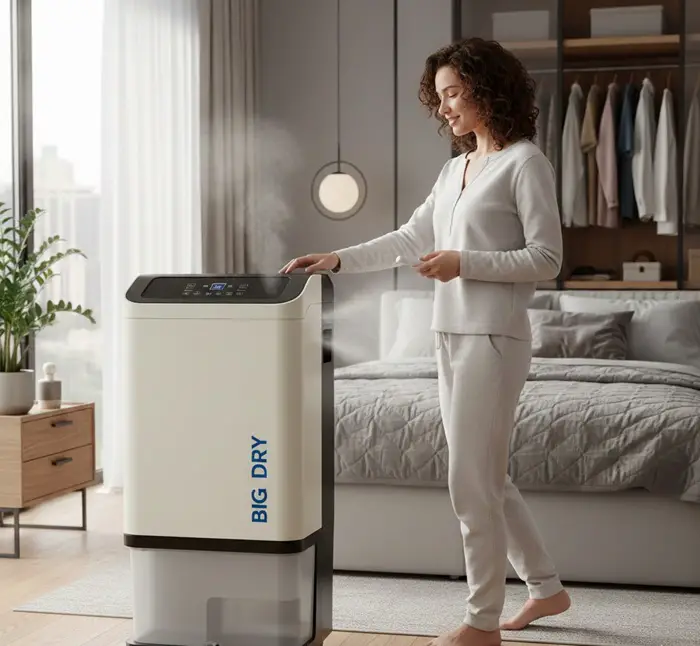
For most homes, dehumidifier size depends on square footage and how damp the space is.
A small room or apartment may only need a 20–30-pint unit, while medium-sized homes often need 35–50 pints.
Larger homes, basements, and very humid regions may require 70-pint or whole-house dehumidifiers.
If your goal is to treat multiple rooms or an entire floor, it’s better to size up rather than use an undersized model.
Use the capacity chart below and consider moisture sources, home layout, and whether you’re dealing with a basement, crawl space, or main living space.
What Size to Consider When Purchasing a Dehumidifier?
Below you’ll find practical sizing recommendations for different types of homes, rooms, and structures. This includes guidance for:
- 1-bedroom homes
- 2-bedroom homes
- 3-bedroom homes
- Mobile homes
- Crawl spaces
- Basements or garages
I have also included a quick dehumidifier size chart for convenience.
1-Bedroom Home (400–800 sq ft)
A 1-bedroom home is typically compact, often with a combined living–kitchen area and one dedicated sleeping space. The moisture load is moderate unless:
- You cook frequently
- You take long, hot showers
- You live in a humid climate
- You have poor ventilation
Recommended Size:
- 20–30 pint dehumidifier (ideal for most small homes)
- If humidity is consistently over 65% → upgrade to a 35–40 pint
Why this size works: Small homes have lower air volume, so small-capacity dehumidifier devices can maintain 45–55% relative humidity without struggling.
Extra Tip: If your unit doesn’t sit centrally (like in the living room), consider a model with a built-in fan capable of circulating air efficiently.
2-Bedroom Home (800–1400 sq ft)
A 2-bedroom home adds more square footage, more airflow restrictions, and usually more water usage (laundry, showers, dishwashing). Moisture gets trapped more easily—especially in older homes.
Recommended Size:
- 35–50 pint dehumidifier
- If the home is particularly damp or musty → go for 50–60 pints
When to consider two units: If rooms are far apart or the home has long hallways, one central dehumidifier may struggle to circulate air—especially in homes with multiple corners and closed doors.
3-Bedroom Home (1400–2500 sq ft)
Larger homes have higher moisture loads, greater air volume, and more structural surfaces for moisture to interact with (like drywall, wooden furniture, and carpets).
For most 3-bedroom homes, a single portable dehumidifier is not enough—unless the home has an open layout.
Recommended Size:
- 50–70 pint units
- Very humid climates (Florida, Gulf States): 70-pint or whole-house dehumidifier
Why? A 3-bedroom home produces moisture from multiple bathrooms, cooking, laundry, and seasonal humidity—and you need large capacity devices to handle this.
Alternate Option: A whole-house dehumidifier, typically installed in the HVAC system, may be more efficient and economical long-term.
Mobile Home (300–1000 sq ft)
Mobile homes tend to trap moisture due to thinner insulation, less ventilation, and flooring that’s more prone to condensation.
Recommended Size:
- 30–50 pint unit, depending on actual square footage
- Smaller units (20–25 pints) work only for very compact, low-moisture spaces
Special Note: Mobile homes often have elevated humidity from beneath the floor—especially in older models.
A dehumidifier paired with under-floor vapor barriers can dramatically improve indoor conditions.
Crawl Spaces (400–2000 sq ft)
Crawl spaces are one of the biggest moisture sources for an entire home. They often hold cool, damp air—perfect conditions for mold, rot, dust mites, and structural issues.
You cannot use a regular portable dehumidifier here. You need a crawl-space-rated model with a drain hose and continuous operation capability.
Recommended Size:
- 50–90 pint crawl-space dehumidifier
- Large or extremely damp crawl spaces may need 90–120 pints
Why so big? Crawl spaces have extremely high moisture loads compared to their size, especially in humid states.
Basement or Garage (600–2500 sq ft)
Basements and garages typically hold cooler, denser air, making them prone to condensation. Because of this, they need larger units than the main living spaces of the same square footage.
Recommended Size:
- 50–70 pint dehumidifier for standard basements
- 70+ pint for wet basements, garages, or spaces with visible condensation
If you’re looking for a dehumidifier for 500 square feet in a cool basement, a 35–45 pint unit generally works. For a dehumidifier for 1000 square feet, size up to 50–60 pints.
Cold Area Warning: If your basement stays below 60°F regularly, consider desiccant dehumidifiers, as refrigerant dehumidifiers lose efficiency in low temperatures.
Quick Dehumidifier Size Chart (Simplified)
| Space Type | Square Feet | Recommended Capacity |
|---|---|---|
| 1-bedroom home | 400–800 sq ft | 20–30 pints |
| 2-bedroom home | 800–1400 sq ft | 35–50 pints |
| 3-bedroom home | 1400–2500 sq ft | 50–70 pints or whole-house |
| Mobile home | 300–1000 sq ft | 30–50 pints |
| Crawl space | 400–2000 sq ft | 50–120 pints |
| Basement/Garage | 600–2500 sq ft | 50–70+ pints |
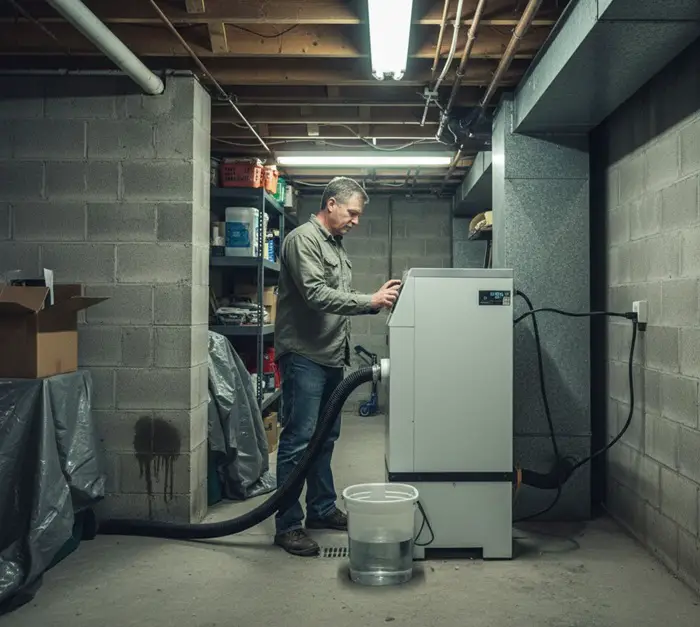
Is It Efficient to Use One Dehumidifier for the Entire House?
The short answer: usually no — unless your home is under 1500 sq ft, has an open layout, and humidity isn’t extreme.
Most portable units are designed for single-space dehumidification, not entire multi-room homes. Here’s why:
1. Airflow Barriers – Closed doors, hallways, corners, staircases, and furniture all prevent air from moving freely. Humidity levels differ dramatically from room to room.
2. Capacity Limitations – Even the largest portable unit (typically 70–95 pints) struggles to pull moisture from multiple rooms. It will run nonstop and still never reach target humidity everywhere.
3. Short Cycling – If you place a large unit in a central room, it may dry that room too quickly while other rooms stay moist.
4. Energy Waste – A single oversized unit trying to condition an entire house is less efficient than multiple smaller devices or a dedicated whole-house system.
When One Dehumidifier Can Work:
- Home is under 1200–1500 sq ft
- Open layout with minimal doorways
- Humidity is mild (50–65%)
- You own a large capacity portable model
When You Should Use Multiple Units or a Whole-House System:
- Home is 1500+ sq ft
- Multiple floors
- Several closed-off rooms
- Basement humidity affects upper floors
- You live in very humid states (Louisiana, Florida, Texas, Alabama)
In those cases, a whole-house dehumidifier integrated into your HVAC is far more effective and energy-efficient.
Is a Bigger Dehumidifier Better – How Do I Know if My Home Needs a Larger Unit?
Not always. While a larger capacity unit removes humidity faster, oversizing can cause short cycling, waste energy, and reduce air filtration effectiveness.
The best approach is sizing accurately using a dehumidifier size chart or whole-house dehumidifier sizing chart.
Bigger is only better when the humidity load is truly high—like in basements, crawl spaces, and large homes.
If you need a larger-sized dehumidifier, the most common signs include:
- Persistent musty smell
- Condensation on windows
- Unit running 24/7
- Humidity never drops below 60%
- Dampness returning within hours after turning the device off
If these occur, upgrading from a small-capacity device to a medium or large-capacity device may be necessary.
Related FAQs
Can I use a dehumidifier for the entire house?
In most cases, a single portable dehumidifier won’t effectively treat a full-size home due to airflow restrictions and capacity limits.
For houses above 1500 sq ft, consider either multiple portable units or a whole-house dehumidifier integrated with your HVAC.
What type of dehumidifier is best for cold basements?
Basements below 60°F often cause refrigerant dehumidifiers to ice up or lose efficiency.
In these cases, desiccant dehumidifiers perform better because they don’t rely on coils and condensation. However, high-capacity low-temperature-rated refrigerant models are also available.
Do dehumidifiers increase electricity bills?
Yes, but usually less than running air conditioners harder due to humidity. Properly sized units run more efficiently than undersized ones that run nonstop.
A well-sized medium capacity device can reduce overall cooling costs by lowering latent load in your home.
Final Thoughts
Choosing the right dehumidifier size is the difference between living comfortably and fighting an endless humidity battle.
Matching your home’s square footage, moisture levels, and layout to the appropriate capacity ensures that your home stays safe, dry, and mold-free.
Small homes usually thrive with small capacity devices, mid-sized homes need medium capacity devices, and larger or humid spaces often require large capacity devices or even whole-house dehumidifiers.
Basements, crawl spaces, and mobile homes each have their own unique requirements, making size selection even more important.
Start with accurate sizing, understand your moisture load, and don’t hesitate to size up when dealing with tricky spaces like basements or crawl spaces.
With the right fit, your dehumidifier becomes a quiet, efficient, virtually invisible guardian of your home’s health.

Meen Smith is a nurse by profession who loves writing online, spending time with her family and caring for the elderly. She has already worked as an associate editor on various moms, babies, home appliances, kitchen, and healthy living blogs. In her spare time, she also enjoys drawing, reading/writing kindle eBooks and improving her skills a bit.