

Before trying to fix your freezing dehumidifier, it is essential to first understand how it works as well as what makes it freeze in the first place.
A standard dehumidifier has a fan, warm condenser coils, cold evaporator coils, and a reservoir or drains meant to hold water.
It also features a humidistat that works similarly to a thermostat in that it measures the humidity level in the room and controls the humidifier throughout its various cycles.
A dehumidifier works by bringing air into the vents, where it moves through cold metal coils. At this point, the air is condensed and made into drops of water.
The droplets are then pumped through a hose for emptying into a floor drain or stored in the reservoir to empty when full, depending on how you want to handle the water for disposal.
When a dehumidifier freezes up, the water drops aren’t able to get to the reservoir, and instead, a cold breeze is generated.
Once the temperature gets warmer, and the ice starts to melt, the reservoir will overflow, which could cause damage to the humidifier itself. This commonly happens in the summer.
Reasons for a Frozen Dehumidifier
There can be more than one cause for dehumidifier coils to freeze up. The most obvious ones include…
1- Temperature
A common reason for a dehumidifier freezing is the temperature of the room it’s in.
Typically, a humidifier operates at its best in rooms that are around 65 degrees Fahrenheit, but a dehumidifier can freeze up anywhere with a lower temperature.
At higher temperatures, the process of the air getting condensed and turned into droplets happens smoothly.
If the temperature is on the lower side, the water vapor won’t condense and will instead freeze.
This creates problems as the steam freezes around the coil, and the airflow is interrupted, causing the dehumidifier to stop working.
2- Air Flow
Airflow being blocked is another common reason for a frozen dehumidifier.
The flow of air could get obstructed if anything stops the fan from properly functioning or if the condenser is otherwise blocked.
Proper and regular dehumidifier maintenance can reduce the chances of this happening while also making you aware of any such problems sooner.
If you notice ice cropping up on your humidifier, it’s a good idea to stop using it for a bit and give it time to defrost.
On the other hand, if your dehumidifier comes with a de-icing button, you can also check it. Many basement-style dehumidifiers will defrost any ice that forms on them quickly.
If the switch is faulty, it can cause trouble since there isn’t anything to melt the ice.
Continuing to use it can cause damage to the frozen coils and may make the motor and compressor both over-function and eventually burn out.
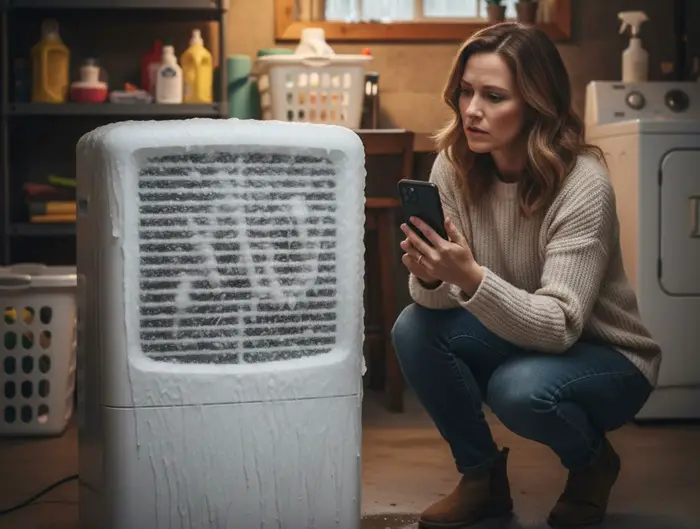
How to Repair a Dehumidifier When the Coils are Icing Up?
Just because the dehumidifier freezes up doesn’t mean it won’t ever work again.
There are a few things you can do to fix it, and because you now have a better understanding of how a dehumidifier works, you can fix it the next time it freezes up while having a good grasp on the actual repairing process.
1- Fan Blade and Blower Wheel
The fan blade and blower wheel are both responsible for keeping the airflow managed and preventing the dehumidifier from freezing up.
It is suggested that you clean the filter regularly by carefully brushing away all of the debris that may have accumulated.
If you still see problems with the airflow after you’ve unblocked the filter, it’s good to take off the cover and look at the coils.
You should also be checking the blower wheel and the blade of the fan. Clean these during your general maintenance routine for best results.
After you have adequately cleaned the fan blade, it’s a good idea to manually move it once to make sure nothing is stopping it from moving once the dehumidifier is started up.
If you notice that the fan blade or blower wheel is damaged, you’ll likely need to repair, if not replace, the part.
2- Humidity System Management
Problems with the humidity management system, commonly referred to as the humidistat, could also cause the coil in the dehumidifier to freeze up.
This technology keeps tabs on the humidity level in the room, and the electric contacts of the humidistat are what is responsible for switching on the compressor in the appliance.
If the humidistat malfunctions, the compressor will stay on since there is nothing to control it, which could result in the coils freezing.
These electric contacts might also freeze shut, which could cause similar issues.
To fix this, unplug the dehumidifier and attempt to turn the humidistat dial. If you hear any clicking, it may indicate that the humidistat is working right.
You can also see if your humidity control is properly functioning using a multimeter.
Remember that the electric contact circuits in the dehumidifier need to be open. If they aren’t, you might have to replace the contacts.
3- Fixing Fan Motor
This motor is what makes the flow of air in the dehumidifier smoother.
To look for problems with the motor, pay extra close attention to the fan while it is running. Use caution when completing this task so as not to damage the motor or injure yourself.
Take a look at the grille and make sure the air is flowing well without any blockage. If you notice blockage, remove the fan cover and clean it.
If the fan isn’t turning or is turning slower than usual, but you hear it humming, you may have to get a replacement.
4- Clean the Coils
When dealing with a dehumidifier freezing up on coils, dirty coils are one of the most overlooked culprits.
Your coils play a crucial role—without them, moisture removal simply wouldn’t happen, and the air leaving the unit wouldn’t be properly conditioned.
Like any essential component, the coils must stay clean to ensure smooth operation.
When dust, grime, or lint builds up around the coils, they struggle to maintain proper temperatures.
As airflow becomes restricted, the unit overheats, and the cold coil can dip below safe operating levels, triggering—you guessed it—a freeze-up.
Solution: Follow the same steps you’d use to inspect the coils for ice, then gently wipe them with a clean cloth to remove dust and residue.
Making coil maintenance a regular habit will drastically reduce dehumidifier freeze-up reasons and help your unit run at peak efficiency.
5- Increase the Room Temperature
If your dehumidifier coil freezes up frequently, the room temperature may be the problem.
Most manufacturers recommend avoiding operation below 60°F because the cold coil simply can’t function correctly in such low temperatures.
One coil is designed to chill and condense moisture, while the other reheats the processed air before releasing it back into your home.
When the surrounding temperature drops too low, the cold coil can no longer regulate itself and starts to ice over, leading to reduced performance or complete shutdown.
Solution: Warm up the room before running your dehumidifier whenever possible. If the coil is already frozen, unplug the unit, let it thaw, then remove the front panel, filter, and protective screws to access the coils.
Use a soft cloth to clear dust, melted ice, or residue. For best results, clean the coils every two months.
6- Replace the Dehumidifier Filter
A neglected filter is another common reason a dehumidifier ends up freezing. The filter acts as a barrier between the outside air and the internal components.
When it becomes dirty or clogged, airflow drops significantly. Low airflow causes the coils to work overtime, often cooling too much and eventually icing over.
Solution: Remove the filter and wash it with mild dish soap under running water. Allow it to dry fully before reinstalling. After cleaning, vacuum any lingering dust.
However, if the filter is older than six months, it’s usually better to replace it altogether—old filters rarely regain proper airflow no matter how well they’re cleaned.
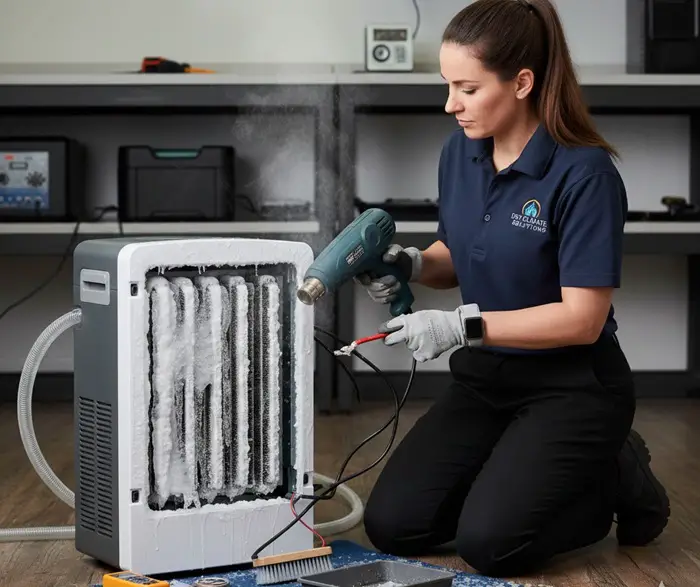
Long-Term Prevention Tips to Avoid Dehumidifier Freeze-Ups in the Future
Preventing your dehumidifier from freezing up long-term requires a combination of proper maintenance, smart usage habits, and a little environmental awareness.
While occasional freeze-ups can happen, following the tips below will significantly reduce the chances and keep your unit performing efficiently year-round.
1. Maintain regular coil and filter cleaning
Dust, lint, and debris are the biggest contributors to restricted airflow—one of the main reasons coils freeze. Clean the air filter every 2–4 weeks and replace it every six months.
Wipe down the coils at least once every two months, or more often if your home collects dust quickly. Clean coils exchange heat efficiently, preventing the cold coil from dropping into freezing temperatures.
2. Keep the room within safe operating temperatures
Dehumidifiers are not designed for very cold environments. Most models shouldn’t run below 60°F (15°C). When temperatures fall, the cold coil absorbs too much chill and starts forming frost.
To avoid this, keep the dehumidifier in a conditioned space whenever possible. If it must run in a basement, ensure the room is slightly warmed or consider using a unit designed for low-temperature operation.
3. Ensure proper airflow around the unit
Restricted airflow causes the compressor and coils to work harder than necessary. Place your dehumidifier at least 12 inches away from walls, curtains, or furniture.
Ensure the intake and exhaust vents are not blocked by objects, dust buildup, or cramped placement. Good airflow helps the unit maintain stable temperatures and prevents overcooling inside the coil chamber.
4. Avoid oversizing or undersizing your dehumidifier
A dehumidifier that is too small will run nonstop, overworking the coils, while one that is too large may short-cycle and fail to regulate moisture and internal temperatures properly.
Check the recommended square footage and pint capacity for your space. Choosing the right size helps maintain consistent performance and reduces freeze-up risks.
5. Schedule routine inspections
Every few months, inspect the power cord, coils, fan blades, and drainage system. Look for dust accumulation, weak airflow, unusual noises, or signs of icing.
Catching small issues early prevents bigger problems later and helps your dehumidifier stay healthy, stable, and freeze-free for years.
Conclusion
There are several different reasons a dehumidifier might freeze up, and catching the issue early prevents long-term damage to the unit.
From restricted airflow and dirty coils to low room temperatures or an aging filter, each problem leaves behind a clear set of clues—if you know where to look.
The best approach is to observe the dehumidifier closely while it’s running and examine how each component behaves under normal operation.
Pay special attention to the fan blade, blower wheel, humidistat, and fan motor, as any malfunction in these parts can disrupt airflow or temperature regulation, leading to ice formation on the coils.

Meen Smith is a nurse by profession who loves writing online, spending time with her family and caring for the elderly. She has already worked as an associate editor on various moms, babies, home appliances, kitchen, and healthy living blogs. In her spare time, she also enjoys drawing, reading/writing kindle eBooks and improving her skills a bit.