
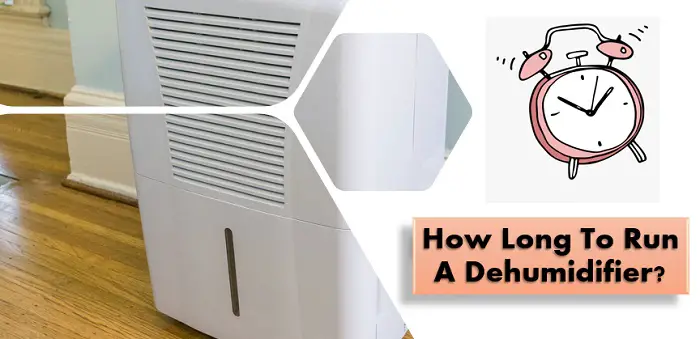
If you’ve ever wondered how long your dehumidifier should run every day, you’re not alone.
This humble appliance does a surprisingly big job: protecting your home from mold, musty odors, dust mites, warped floors, peeling paint, and even structural damage.
Yet most homeowners—understandably—aren’t sure whether they should run the dehumidifier continuously, once in a while, for two hours, overnight, or only when it starts raining sideways.
And then there’s the other internal debate we all have with ourselves: “Am I running it too much? Or too little? Or wasting electricity? Or destroying it slowly?”
The reality is that how long a dehumidifier should run per day depends on the humidity level, the season, the Size of the Dehumidifier, room type, and what’s happening inside your home.
This guide breaks everything down clearly, practically, and technically—so you know exactly when to run the device, when to let it rest, and when your home needs full-time moisture control.
Let’s get into it.
How Many Hours Should a Dehumidifier Run Per Day?
Most homes in the US do best when indoor humidity stays between 40% and 55%. Your dehumidifier’s runtime depends on how far you are from that target.
Below is a general guideline; we’ll then go deeper into specific real-world conditions.
| Humidity Level | Recommended Runtime per Day |
|---|---|
| Mild humidity (55–60%) | 4–6 hours/day |
| Moderate humidity (60–70%) | 8–12 hours/day |
| High humidity (70–80%) | 12–16 hours/day |
| Severe humidity (80%+) | Up to 24/7 operation temporarily |
But the magic lies in knowing what’s happening in your home because different situations demand different dehumidifier running times.
Let’s break down the most common ones.
1. Drying Clothes Indoors
Indoor laundry drying is basically sending a humidity bomb into your living space. A single load of freshly washed clothes can release 1–2 liters of moisture.
Recommended runtime: 6–12 hours, depending on:
- Size of the laundry area
- How tightly the space is enclosed
- Ventilation availability
- Size and capacity of your dehumidifier
A Large Dehumidifier Running can handle this faster, especially if placed close to the drying rack. Some people even place the dehumidifier in a small laundry room and turn it into a “drying chamber,” which works brilliantly.
2. Basement Moisture Control
Basements are naturally damp: buried walls, cool air, limited sunlight, and exposed concrete all hold moisture well.
Typical dehumidifier running time in the basement: 10–24 hours/day, depending on:
- Ground saturation after rain
- Lack of insulation
- Whether the basement is finished or unfinished
- Number of moisture entry points
If humidity stays above 65% constantly, basement dehumidifiers often need to run the dehumidifier continuously just to maintain stable levels. We’ll explore this more in the next major section.
3. Clearing Morning Condensation
If your windows sweat in the morning, it’s usually due to:
- Overnight temperature drops
- High indoor humidity
- Breathing moisture (yes, you release a lot)
- Poor airflow in bedrooms
To clear mild condensation: Run 2–4 hours in the morning, or run the dehumidifier overnight on a low setting. This stabilizes morning humidity and helps reduce mold risks on window frames and drywall.
4. Post-Water Damage or Flooding Recovery
This is where runtime becomes serious.
After a leak, storm, burst pipe, or sump pump failure:
- Materials like drywall, insulation, carpet, and wood absorb huge amounts of water.
- Mold can begin forming within 24–48 hours.
- Air circulation alone won’t cut it.
You need Continuous Dehumidifier Operation Necessary for 24–72 hours, often longer.
Water restoration companies typically run multiple industrial units nonstop until moisture meters confirm dryness. If your unit seems like the dehumidifier never shuts off during this period, that’s normal.
5. After Cooking, Showering, or Using Steam-Heavy Appliances
Everyday household activities can spike humidity far more than most people realize. A single hot shower releases up to 1.5 liters of moisture into the air. Boiling pasta, simmering soups, dishwashing, and using the dryer (especially if it’s not vented properly) also send moisture rising through the house.
If your bath fan or kitchen exhaust isn’t pulling its weight—or if you’re in a smaller home, condo, or older house—you’ll see humidity jump quickly.
Recommended runtime: 1–3 hours after each activity, typically:
- Turn it on immediately after a shower to prevent bathroom mold
- Run 1–2 hours in the kitchen after heavy cooking
- Use 2–3 hours if you’ve been steaming, boiling, or using multiple heat sources
- If humidity stays above 60%, extend runtime accordingly
In homes without good ventilation, a dehumidifier works like an “after-action moisture cleanup crew,” keeping walls, ceilings, grout, and paint dry long-term.
Should Your Basement Dehumidifier Run Constantly 24/7?
The short answer: Sometimes, yes. But only if your basement truly needs it.
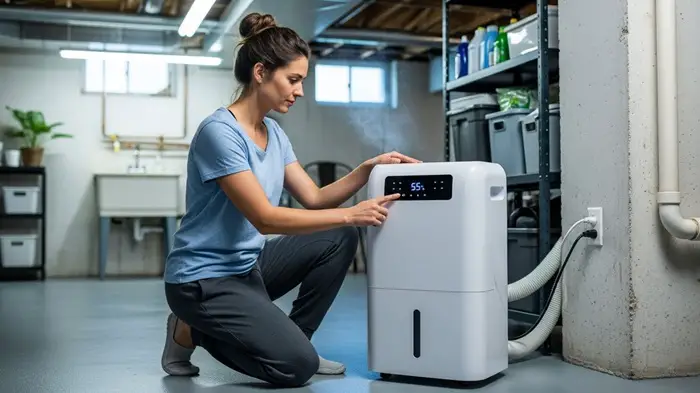
A basement is the one place where dehumidifiers run continuously in basement settings because:
- Cool air holds moisture
- Walls absorb water vapor from soil
- Humidity spikes after rain
- HVAC ducts sometimes sweat
- Appliances (like washers) create humidity
However, your dehumidifier should NOT run constantly if:
- Basement humidity stays under 50% consistently
- Your basement dehumidifier stops running because the auto-humidistat reached the target
- There’s strong airflow and sunlight access
- You only get seasonal moisture, like during summer storms
But if humidity keeps returning to 70%+ shortly after shutting off, then yes—running a dehumidifier continuously is justified.
Here is a chart-style table to help you easily adjust runtime based on moisture conditions.
Basement Dehumidifier Time Setting Guide
| Basement Condition / Humidity Level | Daily Runtime Needed | Notes |
|---|---|---|
| 45–50% (ideal) | 2–4 hours | Maintenance mode only |
| 50–60% (mildly damp) | 6–10 hours | Normal for finished basements |
| 60–70% (damp) | 10–16 hours | Recommend high fan speed |
| 70–80% (very damp) | 16–24 hours | Risk of mold growth |
| 80%+ (wet or leaking) | 24/7 | Requires drying + leak inspection |
| Post-flooding / water event | 24/7 (multiple days) | Use fans + heaters too |
How Much Does It Cost to Use Your Dehumidifier Continuously 24/7?
In general, the electricity cost to run your dehumidifier continuously depends on:
- Your dehumidifier’s wattage
- Your electric rate (national average ~15–18¢/kWh)
- How many hours does it run
Most 30–50-pint dehumidifiers consume 280–600 watts.
Here’s a rough Cost Estimation For 24/7 Operation you should keep in mind when operating your device for long.
For a 500-watt dehumidifier:
- 0.5 kW × 24 hours = 12 kWh/day
- 12 kWh × $0.16 = $1.92/day
- $57.60/month
- $691/year
Larger 70–95 pint models cost slightly more.
Key Scenarios Where 24/7 Dehumidifier Operation Becomes Essential in Home
If you live anywhere from the misty mornings of Portland, the storm-heavy summers of Atlanta, the coastal salt air of Tampa, or the glacier-grade winters followed by muggy springs in Chicago, you already know: humidity doesn’t politely wait for you to turn on your dehumidifier.
It quietly creeps into drywall, hardwood, insulation, basement slab edges, and even your HVAC ducts.
Modern homes — especially energy-efficient ones in places like Denver, Seattle, and Boston — are built tighter than ever. Great for heating bills, terrible for moisture migration.
When relative humidity stays high, water vapor diffuses through porous materials, increases dew-point risk, encourages microbial activity, and accelerates hygroscopic moisture absorption inside walls and floors.
In these situations, intermittent dehumidifier use simply isn’t enough. You need continuous moisture extraction to stop structural damage before it begins.
That’s exactly when 24/7 dehumidifier operation becomes not just recommended… but essential.
Below are the key technical scenarios where you should leave your dehumidifier running even when you’re not home.
1. Humidity Consistently Above 65%
When RH remains above 65%, you’re in the perfect zone for:
- Mold spores to germinate (they activate around 60%+ RH)
- Dust mites thrive (ideal around 70% RH)
- Volatile organic compounds (VOCs) to intensify
- Moisture absorption in wood framing, furniture, and flooring
Technical reality: At high humidity, moisture drives into hygroscopic materials due to vapor pressure differentials. Once absorbed, wood swells, finishes cracking, and structural members slowly warp.
Keeping RH capped at 50% requires continuous moisture extraction — sometimes round the clock during humid summers in cities like Houston, New Orleans, and Miami.
2. Basements with Groundwater Seepage
Concrete isn’t waterproof; it’s a sponge. Basements in regions with high water tables — Ohio Valley, New Jersey, Maryland, Minnesota, etc. — often experience:
- Capillary rise (water climbing through microscopic concrete pores)
- Hydrostatic pressure pushes moisture through cracks and joints
- Moisture vapor drives from the surrounding soil
Why 24/7 operation matters: A basement constantly wicking groundwater never “finishes” drying. Turn off the dehumidifier for even a day, and humidity spikes again because the slab continues emitting moisture.
3. Post-Leak or Flooding Events
After a plumbing leak, sump pump failure, or localized flooding, moisture doesn’t just sit on surfaces — it travels:
- Behind baseboards
- Under subfloors
- Into fiberglass insulation
- Into paint and drywall paper backing
Most US restoration pros (IICRC standards) recommend continuous drying for 48–72 hours minimum, often more depending on wall moisture readings.
Water trapped in confined spaces can take weeks to evaporate fully. Only constant dehumidification prevents mold bloom and structural degradation.
4. Carpeted Basements
Carpet padding is basically a moisture sponge with a deceptive “dry surface.” Humidity stays trapped at the padding–slab interface.
Particularly common in colder regions like Michigan, Maine, Pennsylvania, and Wisconsin, where basement slabs stay cold year-round.
Why 24/7 is critical: When warm indoor air hits the cold slab, condensation develops beneath the carpet — invisible but persistent. Continuous dehumidification prevents microbial growth and musty odors.
5. Coastal Regions or Humid Climates
Homes near coasts — San Diego, Charleston, Virginia Beach, Gulf Coast, South Florida — fight year-round humidity often between 60–85%.
Salt air makes things worse by accelerating the corrosion of:
- HVAC coils
- Appliances
- Electrical components
Coastal humidity doesn’t cycle; it’s constant. Turning off the dehumidifier allows moisture equilibrium to reset in just hours.
6. Homes With Poor Insulation or Cold Basement Walls
If your basement walls feel cool to the touch in summer, that’s a sign of poor insulation or contact with deep soil temperatures.
Here’s what happens:
- Your air conditioner cools warm indoor air
- That cooler air drops below the dew point when touching cold concrete
- Condensation forms
- Mold colonizes the wall or studs
This problem is extremely common in older homes in St. Louis, Pittsburgh, Cleveland, and Boston.
Why 24/7? Cooling cycles don’t run long during mild days, so moisture stays trapped unless constantly removed.
7. Houses That Retain Moisture After Cooking, Showering, or Laundry
If your exhaust fans are weak, don’t vent outdoors, or are rarely used, humidity spikes remain trapped in:
- Bathrooms
- Kitchens
- Laundry rooms
- Hallways
Open-concept homes in Texas, California, and Arizona (during monsoon season) often struggle with humidity migration into adjoining rooms.
Moisture load from showers increases indoor RH by 10–25% in minutes. Without sustained removal, it takes hours to normalize.
8. Indoor Pet Areas
Pets add more moisture than people expect:
- Breathing and panting
- Spilled water bowls
- Cleaning/sanitizing
- Wet fur
- Indoor litter or potty areas (especially for multiple pets)
Homes with pets — especially in humid states like Florida, Alabama, or Georgia — experience consistent background humidity that accumulates in flooring and upholstery.
Why continuous operation helps: Dehumidifiers maintain steady-state moisture levels, so RH doesn’t creep upward during the day.
9. Large Homes Where HVAC Cannot Dehumidify Properly
Central AC systems dehumidify only when cooling. That means:
- Shoulder seasons (spring/fall) = poor dehumidification
- Oversized HVAC = short cycling → almost no moisture removal
- High square footage = insufficient CFM and latent capacity
This is common in suburban homes across Texas, North Carolina, Tennessee, Illinois, and Colorado.
AC removes moisture when the coil temperature is < the dew point. Short run-times = inadequate latent load removal → humidity builds up → dehumidifier must run constantly.
10. Rainy Seasons in the Midwest, Northeast, Southeast & Pacific Northwest
Certain US regions experience long stretches of humid, rainy months:
- Seattle, Portland → marine layer & drizzle
- Chicago, Detroit, Cleveland → spring thaw & summer storms
- Atlanta, Nashville → long humid seasons
- New York, New Jersey, Connecticut → humid summers + coastal storms
These climates maintain high outdoor RH for weeks, which infiltrates through:
- Crawlspaces
- Attics
- Basements
- Window frames
- Door gaps
Why 24/7 is justified: Outdoor RH remains above indoor levels almost continuously, causing indoor moisture gain even when windows are closed.
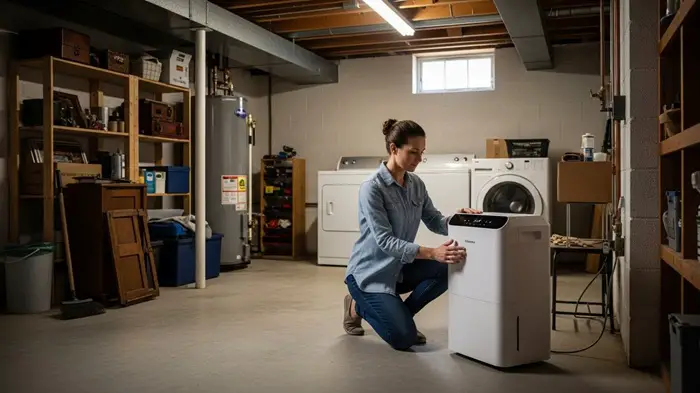
Safety Guidelines for Extended Dehumidifier Operation – Tips to Reduce the Runtime
To maximize both safety and efficiency—while lowering the total runtime of your dehumidifier unit—you need to manage airflow, electrical load, moisture sources, and ambient temperature.
The following seven guidelines combine safety practices with technical tweaks that reduce unnecessary 24/7 operation of your dehumidifier.
1. Use auto shut-off, a humidistat & temperature-aware modes
Your dehumidifier should run based on actual RH, not habit. Units with built-in humidistats read room humidity, compare it to your target setpoint (ideally 45–50%), and cycle the compressor accordingly.
Why it matters technically: Continuous compressor operation increases wear on refrigerant lines, raises coil temperature, and spikes energy bills. A humidistat prevents unnecessary latent-load removal once equilibrium is reached.
Many models also adjust performance based on room temperature—critical for areas like Denver basements or New Hampshire crawl spaces, where temperatures swing drastically.
2. Always plug directly into a wall outlet (no extension cords)
Dehumidifiers demand a steady current and can overload undersized or low-quality extension cords.
High-amperage appliances experience a voltage drop through long or thin-gauge cords. Low voltage forces the compressor to work harder, increasing internal temperature and risking insulation breakdown within the windings.
A grounded, dedicated wall outlet keeps the voltage stable and reduces fire hazards.
3. Use continuous drainage (gravity hose or built-in pump)
If you expect long runtimes, eliminate the reliance on the internal bucket.
Why: Buckets overflowing or frequent auto shutoffs cause rapid stop-start cycles, which are hard on the compressor. A drainage hose or pump maintains steady operation, prevents moisture re-evaporation, and supports safe 24/7 use.
4. Maintain airflow: clean filters & keep 8–12 inches of clearance
Airflow is everything in vapor removal. Clean filters every 2–4 weeks, especially in dusty basements.
Dirty filters create:
- Reduced CFM
- Elevated head pressure in the compressor
- Hotter condenser coils
- Longer compressor cycles
- Up to 20–30% increased runtime
Also, keep the machine at least 8–12 inches away from walls or furniture so intake and exhaust aren’t trapped in a feedback loop.
5. Monitor coils for frost, sweat, or excess heat
A dehumidifier is essentially a small HVAC system. The evaporator absorbs moisture by dropping below the dew point; the condenser rejects heat back into the room.
In winter: If the room temp drops below 60°F, the evaporator coil can freeze. Ice blocks airflow, overheats the compressor, and forces the emergency shutoff. Use defrost mode or avoid running in cold basements in winter.
In summer: Coils operate optimally when room temperatures are between 68–90°F. High humidity + warm temps = efficient moisture extraction.
6. Prevent airflow obstruction & watch for electrical warning signs
Never block intake/exhaust vents—restricted airflow kills efficiency and overheating follows quickly.
Also check:
- Plug temperature
- Outlet discoloration
- Any buzzing or burning smell
An overheating plug often indicates poor contact or excessive resistance, causing the connection to act like a heating element. Stop the operation immediately if this happens.
7. Reduce runtime by controlling moisture sources (ventilation, insulation & placement)
A safely running dehumidifier is good — but a dehumidifier that doesn’t need to run constantly is better. Lower the moisture load in the room so the machine cycles less.
Here are a few key runtime-reduction strategies that can help:
Add ventilation: Open windows on dry days; install passive vents in basements.
Seal cracks and gaps: Moisture infiltrates through foundation cracks, sill plates, rim joists, and HVAC chases.
Insulate cold surfaces: Cold pipes, ducts, and walls sweat when warm, humid air contacts them.
Use exhaust fans:
- Bathroom: 20 minutes after showers
- Kitchen: While cooking
Run ceiling fans: Moves stagnant air and lowers localized RH pockets.
Place the unit correctly: Center of room or nearest moisture source (e.g., sump pit, laundry area).
Use AC or heat strategically: Warm air holds more moisture → AC removes it efficiently → reduces dehumidifier workload.
Upgrade to a larger unit if needed: A 20–30 pint model in a large basement will run constantly. A 50–70 pint unit restores proper duty cycle.
Conclusion – So, How Long Should You Use a Dehumidifier Per Day?
There’s no single perfect daily runtime because humidity, weather patterns, and the room you’re targeting all influence how long your dehumidifier should run. In general, mild indoor humidity around 40–55% may only require 2–6 hours a day, while levels between 60–70% often need 8–16 hours.
Anything above 70% usually calls for temporary 24/7 operation until conditions stabilize. Basements tend to need daily dehumidification simply because they trap moisture, and after leaks or water damage, the unit should run continuously until the area is fully dry.
Ultimately, your hygrometer and the unit’s automatic shutoff are the most accurate judges of how long to run it. Once humidity drops, your home will feel fresher, less sticky, and free from musty odors. Managing indoor moisture becomes simple once you understand how your home behaves.
When you pair your dehumidifier with good ventilation, insulation, drainage, and smart airflow habits, it becomes part of a complete moisture-control strategy that keeps your living spaces healthier, cleaner, and far more comfortable year-round.

Meen Smith is a nurse by profession who loves writing online, spending time with her family and caring for the elderly. She has already worked as an associate editor on various moms, babies, home appliances, kitchen, and healthy living blogs. In her spare time, she also enjoys drawing, reading/writing kindle eBooks and improving her skills a bit.